The Paris Catacombs: History, Hauntings & How to Visit
Twenty metres beneath the streets of Paris, in tunnels the city dug to build itself, lie the bones of more than six million Parisians — stacked…
Reader’s note: supernatural accounts are presented as folklore and reported experiences, not established fact.
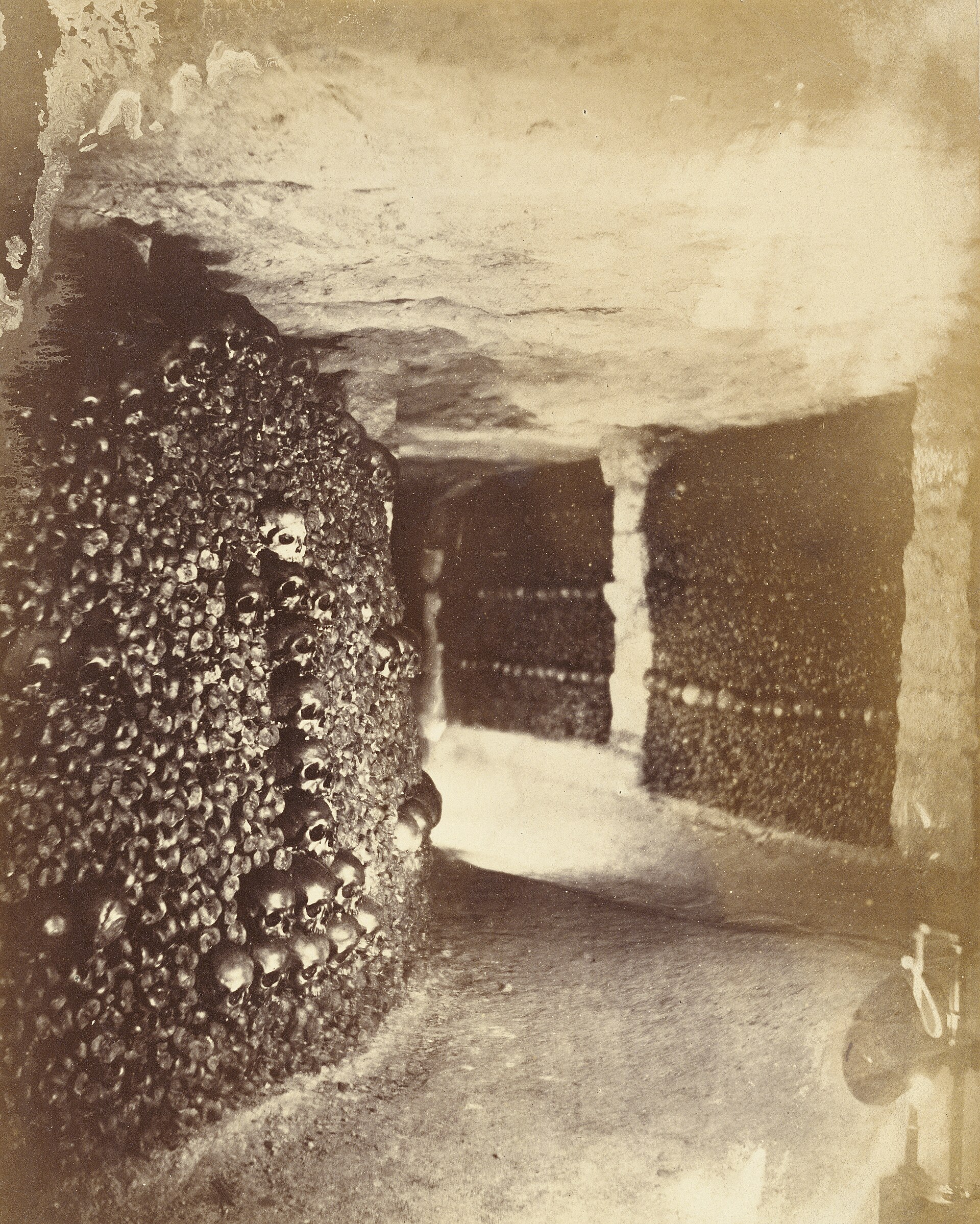
Twenty metres beneath the streets of Paris, in tunnels the city dug to build itself, lie the bones of more than six million Parisians — stacked into walls, arranged into patterns, and labelled with the cemeteries they came from. The Paris Catacombs are the most famous underground in the world, and the most misunderstood. They are not catacombs at all, in the proper sense: nobody is buried here. They are a municipal ossuary built inside abandoned limestone quarries, and the name is a nickname borrowed from Rome. For all the ghost stories, only one death has ever been officially confirmed underground. The real horror is documented history — a cemetery that burst its walls, six million dead moved by night, a prisoner’s fortress carved from memory in the dark, and a war fought beneath the city. What follows is the visit, the history, and the honest check, in the order you walk it.
A note on prices and timing before you plan: figures below are what research found in November 2026, from the official site and recent guides — and several conflict across sources, so treat every figure as a starting point and check the current rate before booking. The Catacombs closed for five months of renovation and reopened on 8 April 2026, so any guide written before spring 2026 may describe the old route. Nothing here is an affiliate link — where a tour or booking is worth knowing about, we name it so you can find it yourself.
1. The Descent: Denfert-Rochereau & the Gate of Hell
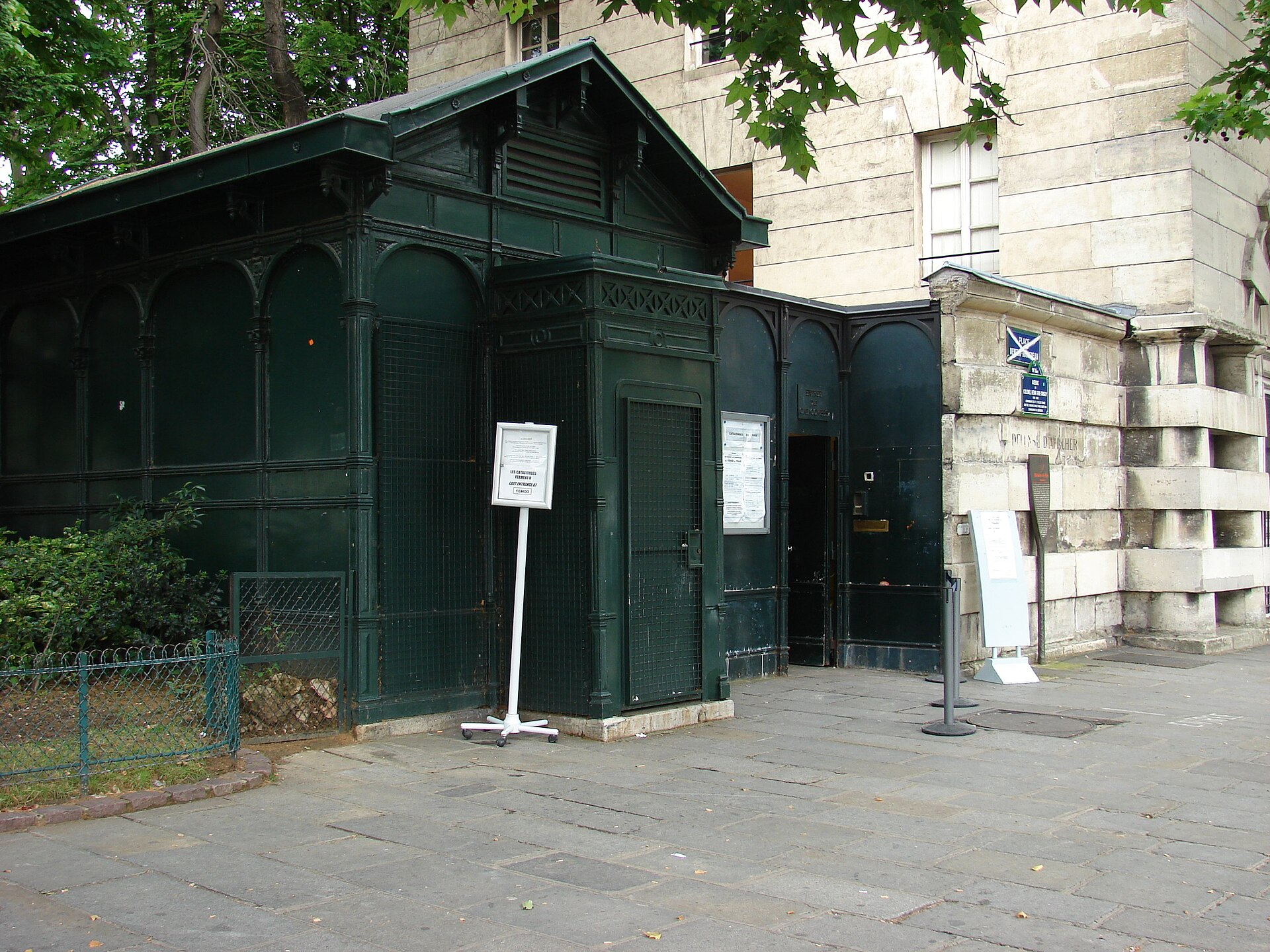
The visit: The entrance is at 1 Avenue du Colonel Henri Rol-Tanguy, on Place Denfert-Rochereau in the 14th arrondissement — Métro lines 4 and 6 and RER B to Denfert-Rochereau. The exit is not the entrance: you emerge at 21 bis avenue René-Coty, about 700 metres away, where the bookshop is. Open Tuesday to Sunday, 09:45–20:30, last admission 19:30; closed Mondays, 1 January, 1 May and 25 December. The route is a 1.5 km one-way walk, about 45–60 minutes, 131 steps down and 112 up, 20 metres below street level, at a constant 14 °C year-round — bring a layer even in summer. Bags are limited to 40 × 30 × 20 cm.
The 7-day rule — read this before you book: Official tickets are sold only online, through the Paris Musées ticket office, and released exactly seven days in advance. Before that window opens the shop shows nothing at all, which is not the same as sold out — and once it opens, slots go fast, because only about 200 people are allowed underground at once. There are no tickets at the door. The first slot of the day (09:45, Tuesday to Thursday) and the evening slots after 18:00 are the quietest. Full rate is €31, reduced €25 (18–26, students, teachers), children 8–17 €15, under-8s free — audio guide included in every paid ticket. The Paris Museum Pass is not valid here. If the official slots are gone, resellers offer skip-the-line and special-access tours from around $43 to €139 and up, with restricted-access tours from about $235 — prices conflict widely across resellers, so treat them as a range and try the official €31 ticket first.
The history: The square was once the Place d’Enfer — “Hell Square” — named for the Barrière d’Enfer, the “Gate of Hell,” one of Ledoux’s tax-collection gates in the old Farmers-General wall. It was renamed for Colonel Denfert-Rochereau, who held the city of Belfort against the Prussians in 1870–71; his Lion of Belfort stands on the square. The entrance now sits in the restored Ledoux pavilion, renovated in 2019.
Honest check: The name on the gate is a coincidence of history, not a warning — but it is the best-named entrance to any haunted site in the world, and the article should say so. You descend through the Gate of Hell, past a lion, into the empire of the dead. Paris did not plan the poetry. It just happened that way.
2. The Quarries: The Stone That Built Paris
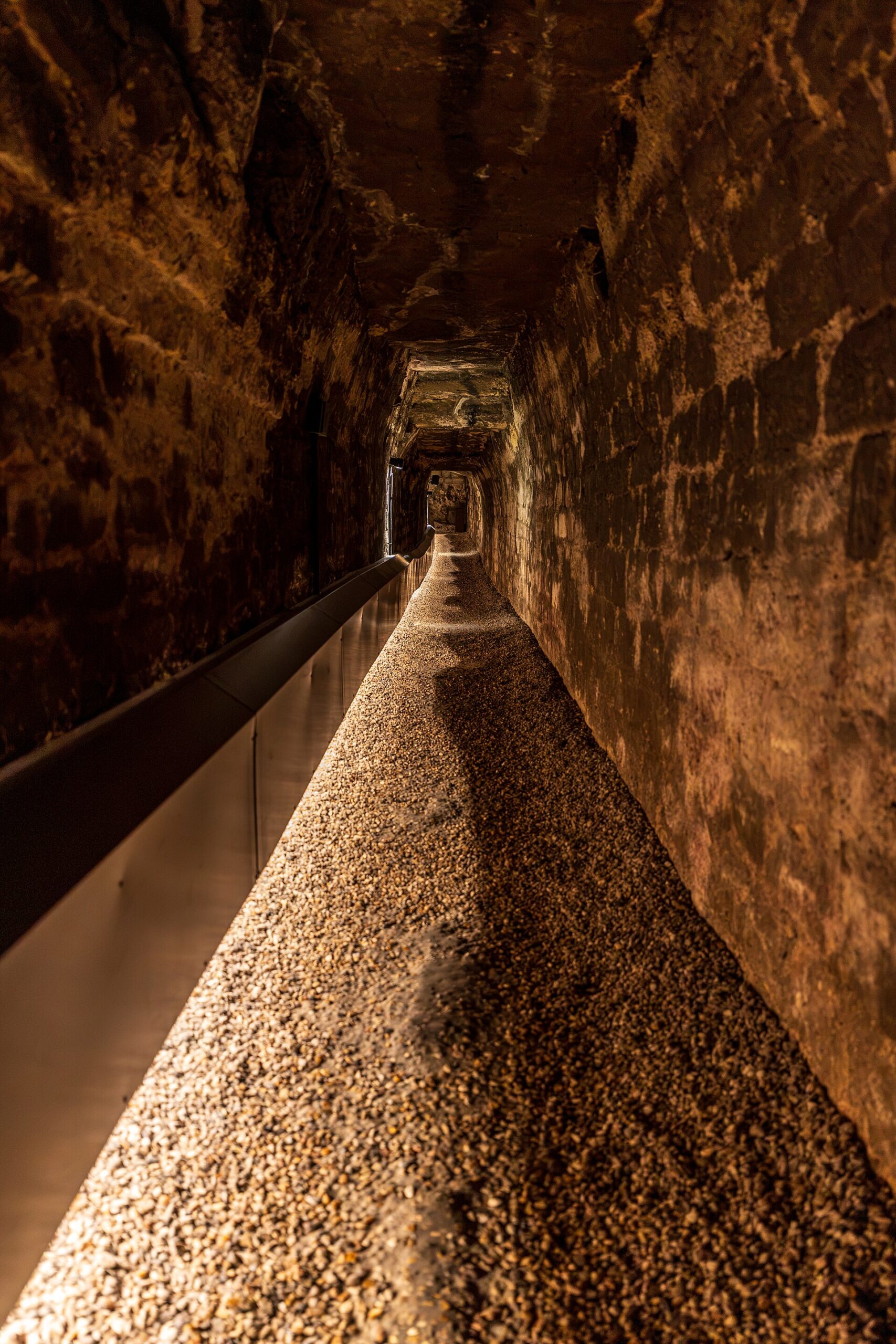
The visit: The first stretch of the route is not the ossuary at all — it is bare quarry tunnel, and it is worth your attention before the bones begin. Look for the chisel-marks scored into the walls by hand-worked picks, the masonic symbols left by quarrymen’s confraternities, and the street-name plaques that 19th-century inspectors set into the stone so they could navigate from below. The Atelier, a wider workshop chamber, still shows stone benches and the original lantern hooks set into the rock.
The history: Paris is built from Lutetian limestone quarried from beneath the Left Bank — the same stone as Notre-Dame and the Louvre. Quarrying ran from Roman times, but the post-12th-century method was haphazard: dig a well down to the deposit, extract horizontally until it ran out, then abandon the workings and forget them. As the city annexed its suburbs and built over them, whole districts came to stand on uncharted voids. The reckoning began in 1774, when a house on the rue d’Enfer collapsed into the mine below it. Louis XVI ordered an investigation, and the result was the Inspection Générale des Carrières — the General Inspection of Quarries — under Charles-Axel Guillaumot, which mapped and consolidated the network. The inspection galleries its engineers built are what the ossuary sits in.
Honest check: The tunnels were never built as tombs. Every “catacomb” story starts with a stone quarry — the dead arrived two centuries after the stone left. And the scale is easy to get wrong: the quarry network is given as 200, 250, 280, 300 and 320 km across different sources, so “roughly 300 km” is the honest figure, with the estimates varying. The public route is 1.5 km of it — about half of one percent.
3. Les Innocents: The Cemetery That Burst
The history: Paris’s Right Bank settlement began with cemeteries near its centre — the opposite of the usual pattern — and the most central of them became the city’s principal burial ground. Saints-Innocents, Les Innocents, beside the Les Halles market, took burials from 1130 for more than six centuries. By the late 18th century it was a two-metre-high mound of earth over mass graves, holding the remains of around two million Parisians plus the dead of the Hôtel-Dieu hospital and the Morgue. To make room for more, the long-dead were exhumed and their bones packed into charnel galleries inside the cemetery walls. It poisoned the surrounding wells and caused disease outbreaks. On 31 May 1780, after heavy rain, a basement wall in a property adjoining the cemetery collapsed under the weight of the mass grave behind it, spilling decomposed remains into the cellar. The cemetery was closed that year, and all burials within the city walls were forbidden.
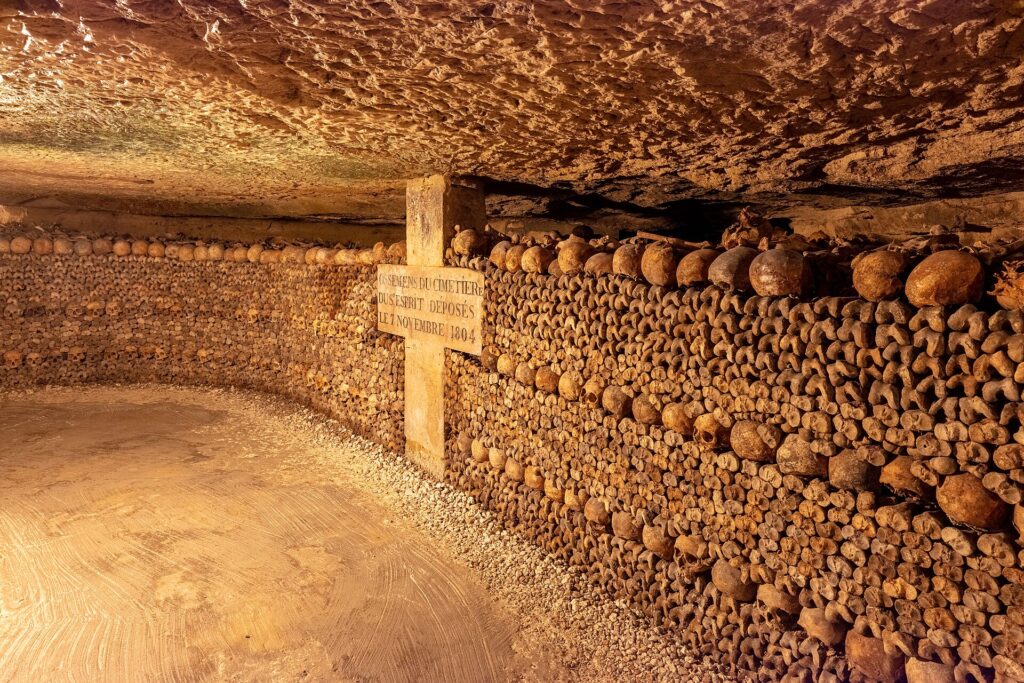
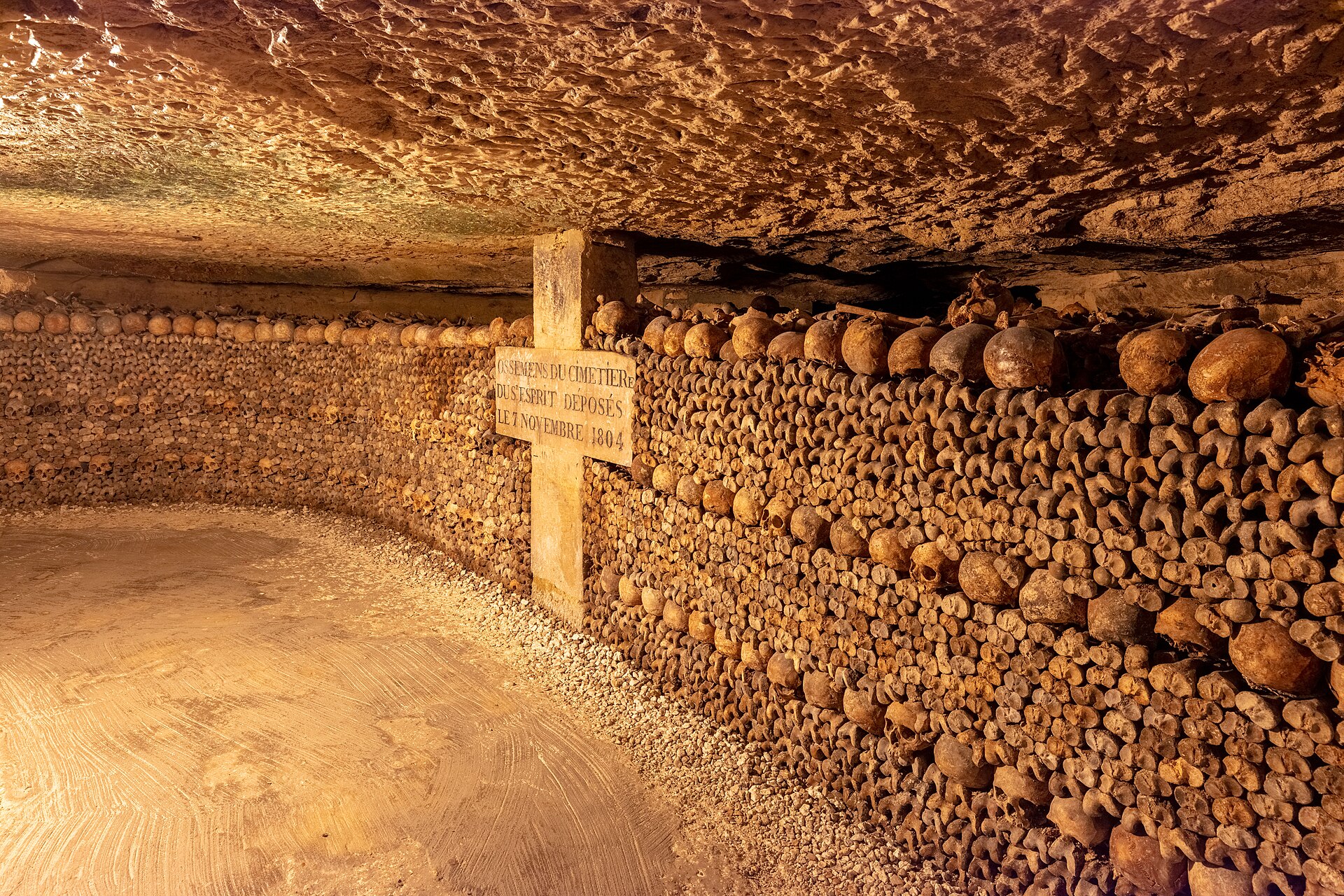
The transfer: Police Lieutenant-General Alexandre Lenoir proposed the empty quarries; his successor Thiroux de Crosne made it law in late 1785; Guillaumot directed the work. On 7 April 1786 the Tombe-Issoire quarries were consecrated as the Paris Municipal Ossuary, and the nightly processions began — black-covered wagons, accompanied by priests, carrying the dead across the city in the dark. The majority of Paris’s cemeteries were emptied within two years; transfers continued until about 1814, with further deposits into the 1860s as Haussmann rebuilt the city. The cemeteries moved include Saints-Innocents, Saint-Étienne-des-Grès, Madeleine, Errancis, Notre-Dame-des-Blancs-Manteaux and Saint-Esprit — whose plaque, recording remains deposited on 7 November 1804, is visible in the photograph above.
The lore (reported): The ossuary is said to hold the remains of more than six million people — and among them, the Revolution’s victims and executioners, mixed together in the same bone piles: Robespierre, Danton, Desmoulins, Lavoisier, Charlotte Corday, Madame Roland, Madame du Barry, Saint-Just, Couthon, the 22 Girondists. Unidentifiable now, and inseparable.
Honest check: “Six million” is the standard figure, but sources give six to seven million, and the records were incomplete and inconsistent — treat it as an estimate, not a count. And nobody is buried here. An ossuary stores bones; a catacomb buries bodies. The distinction matters, and it is why the site’s real name is the Ossuaire Municipal. The famous dead are in there, by the cemetery records — but no plaque, no marker and no guide can tell you which skull is Robespierre’s. Anyone who claims otherwise is selling something.
4. Héricart de Thury & the Empire of Death
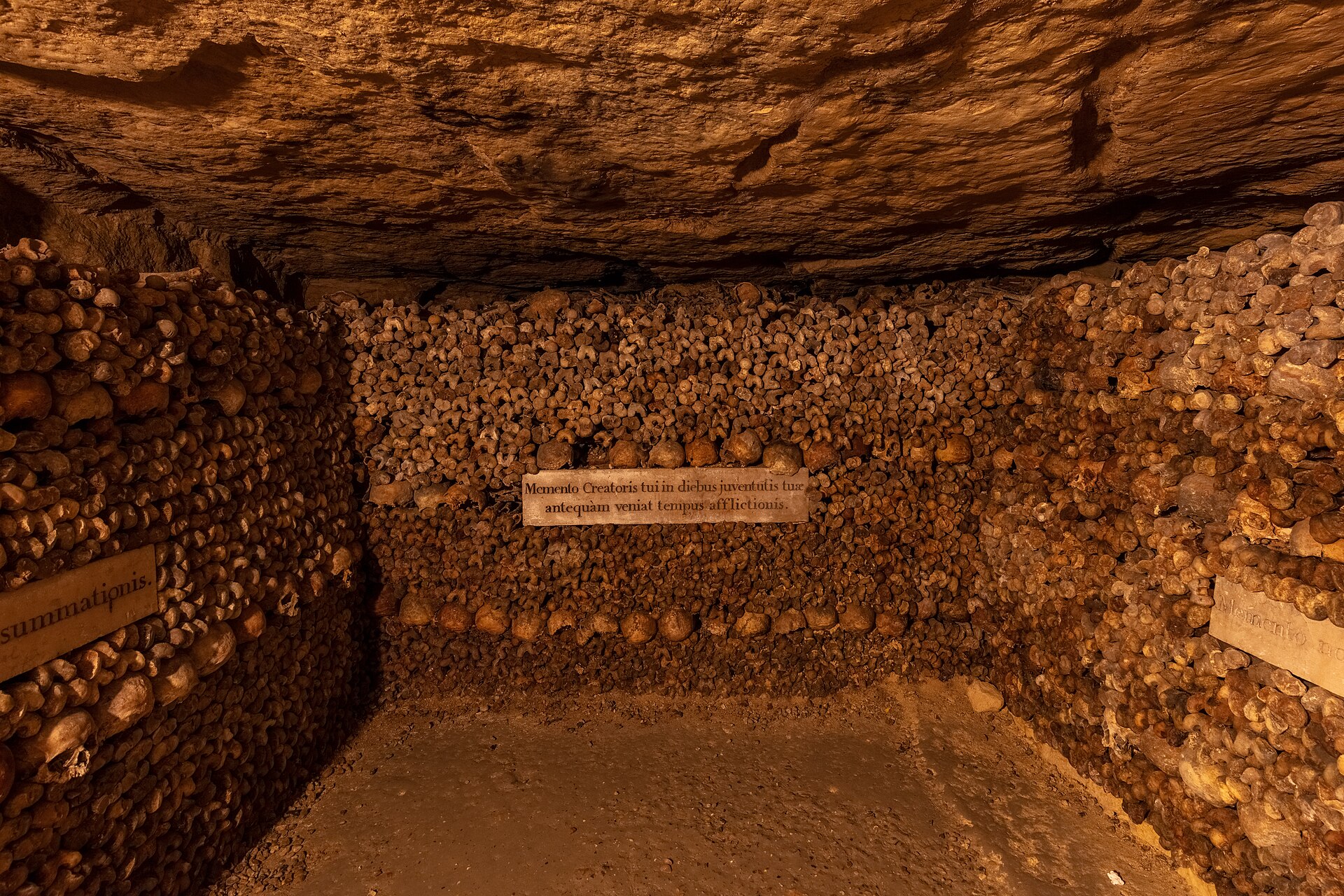
The history: For its first 24 years the ossuary was a disorganised bone repository — remains tipped in heaps down the shafts. Louis-Étienne Héricart de Thury, who took over the quarry inspection service in 1810, spent the next four years turning it into a visitable mausoleum. Skulls, femurs and tibias were stacked into patterned walls — hagues, a decorative facing of long bones and skulls with loose bones piled behind. Stone plaques recorded which cemetery each section came from, and the year of transfer. He added monumental tablets and archways with ominous inscriptions, a room of minerals found under Paris, and a display of skeletal deformities found during the work. He walled the ossuary off from the rest of the Left Bank tunnel network for visitor safety, and published his Description des catacombes de Paris in 1815.
The inscriptions: The gateway to the ossuary reads “Arrête, c’est ici l’empire de la Mort” — “Stop, this is the empire of Death.” The tablets inside carry verses on mortality, including the Ecclesiastes plaque in the photograph above: “Memento Creatoris tui in diebus juventutis tuae antequam veniat tempus afflictionis” — “Remember your Creator in the days of your youth, before the days of trouble come.” The ossuary became a novelty venue for concerts and private events in the early 19th century; limited visits date to 1809, and regular public visitation followed in 1874, after renovations and new accesses at Denfert-Rochereau. Since 2013 it has been one of the fourteen City of Paris Museums.
The lore (reported): In 1861 the photographer Nadar took the first pictures ever made underground here, using an artificial light he had patented that year. The exposures reportedly ran as long as eighteen minutes — so he posed mannequins as the workers. The first catacomb photoshoot had models who couldn’t blink.
Honest check: The bone walls are not how the dead were found — they are a 19th-century curator’s art installation. The patterns, the crosses, the inscriptions are all Héricart’s Romantic-era staging of mortality. Beautiful, deliberate, and 200 years old. What you are looking at is not a grave. It is a museum of death, designed by a mining engineer who understood that how you arrange the dead is a statement about the living.
5. The Port-Mahon Sculptures: A Prisoner Carves His Memory
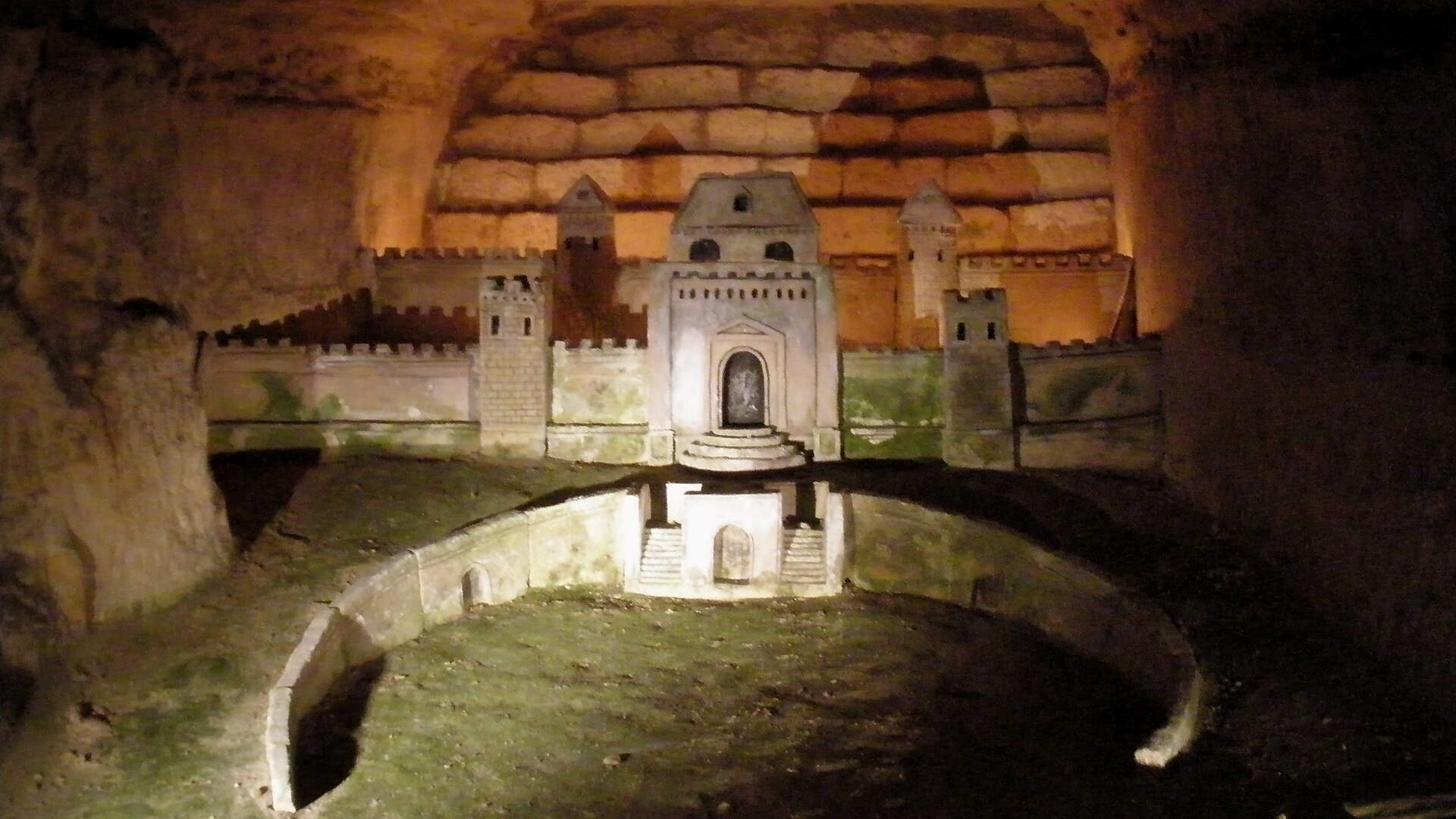
The visit: Further along the route, in a recess off the Port-Mahon corridor, stands the strangest thing underground: a miniature fortress, some forty feet of bas-relief and projecting sculpture, carved directly out of the quarry limestone. It is on the public route — do not walk past it. The corridor is named for it.
The history: The carver was François Décure, a quarryman who had served in Louis XV’s armies during the Seven Years’ War (1756–1763) and spent years as an English prisoner at Port Mahon on the island of Menorca. From 1777 to 1782, during lunch breaks and before and after his shifts, working by torchlight with quarryman’s tools, he carved three sculptures from memory: the fortress of Port Mahon, where he had been imprisoned; Port Philippe, the Spanish fort across the harbour; and the Quartier de Cazerne, the most detailed of the three. He also carved an altar for blessing the bones and a footbath for the workers. The carvings predate the ossuary — Décure was decorating a working quarry, not a tomb.
The lore (reported): Décure was killed in 1782 while digging a staircase to give street-level access to his sculptures, so that people above could come down and see them. The sculptures were damaged during the Revolution’s mass burials and conserved in 1854, and several times since.
Honest check: Décure carved from memory, more than fifteen years after Menorca, and the fortress he knew was replaced halfway through the 19th century — so whether the sculpture is true to life is unknowable. It is a memory carved in stone, not a portrait. And the manner of his death varies by telling: most sources say he was crushed in a collapse; some say a fall. What is certain is that he died trying to let other people see his work — and that his is the most human thing underground. A prisoner who came home and rebuilt his prison, by hand, in the dark.
6. The Crypt of the Passion & the Midnight Concert
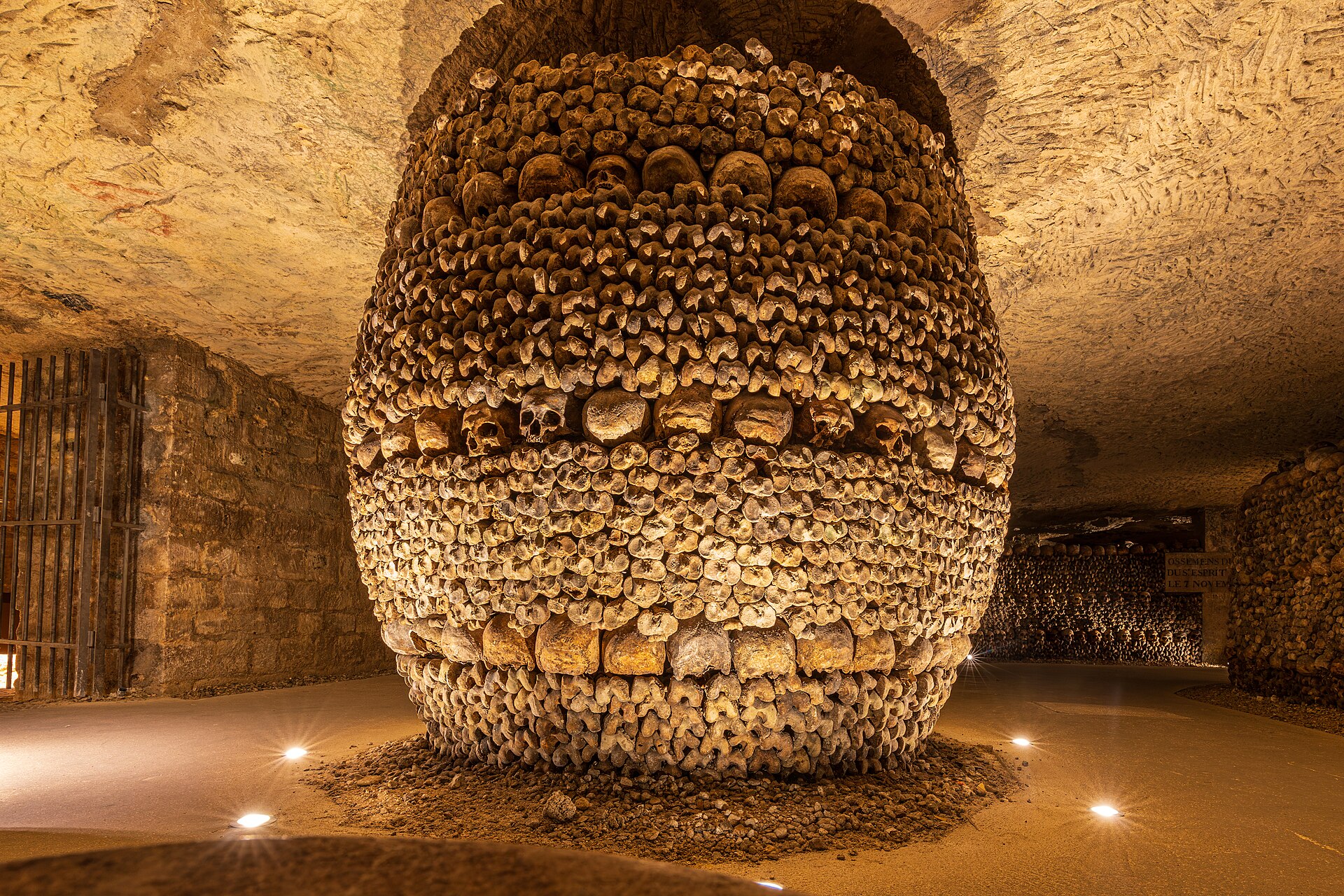
The visit: Near the end of the route, the Crypt of the Passion — also called the Tibia Rotunda — holds the ossuary’s most photographed object: a supporting pillar hidden under skulls and tibias arranged in the shape of a barrel. It is part decoration and part engineering, which is the most Parisian sentence ever written about bones. Nearby, the Sacellum crypt holds the altar where the bones were blessed — “Hic in somno pacis requiescunt majores,” “Here in the sleep of peace rest our ancestors” — and the route also passes the Samaritaine fountain, once used to make mortar, and the tomb of Nicolas Gilbert, the “cursed poet,” whose sarcophagus hides a structural reinforcement.
The history: On 2 April 1897, a night concert was organised in the crypt from midnight to 2 a.m., advertised in the newspapers. Over a hundred thrill-seekers descended by lamplight to hear Chopin’s Funeral March and Saint-Saëns’ Danse Macabre among the bones.
Honest check: A concert among the bones sounds like a gimmick, but it was 1897, and the audience came by choice, in evening dress, to hear the Danse Macabre where the dead actually were. The Victorians understood this place better than we do. One modern joke to skip: the barrel is sometimes said to resemble Obelix from Astérix. It is a joke, not a historical claim, and the crypt deserves better than it.
7. Philibert Aspairt & the Lost
The history: Philibert Aspairt was a doorkeeper at the Val-de-Grâce hospital. On 3 November 1793, in the middle of the Revolution, he entered the quarries through a staircase in the hospital courtyard — reportedly in search of wine or liquor in an underground cellar, in the fuller telling the Chartreuse left behind by fleeing monks. His light failed. He could not find the exit. His body was found eleven years later, on 30 April 1804, and buried where it lay — identified, the story goes, by the hospital key ring still hanging from his belt. His tomb sits in the restricted network under the rue Henri Barbusse, near Boulevard Saint-Michel, where cataphiles leave candles on it. The inscription reads: “À la mémoire de Philibert Aspairt, perdu dans cette carrière le 3 novembre 1793; retrouvé onze ans après et inhumé en la même place le 30 avril 1804.”
The warning, in the present tense: In June 2017, two boys aged 16 and 17 entered the illegal quarry network with a map. Their phones died — there is no reception two storeys down — and they became disoriented in total darkness. Their parents raised the alarm after 48 hours; firefighters, a K9 team and rescue specialists searched, and the boys were found in the early hours of 14 June, about 72 hours underground, after rescuers heard faint cries for help. Both were treated for hypothermia and released. The Paris Fire Service said: “It was thanks to the dogs that we found them.” The museum operator told AFP that nobody has ever been lost in the public section — and that is the point. The public route is 1.5 km, lit, and one-way. Everything else is unlit, unmarked, and illegal: entry to the quarries outside the museum route has been banned since a prefectural order of 2 November 1955, with a fixed fine of €135.
The lore (reported): Aspairt is the cataphiles’ patron saint, and some say his ghost — the “Phantom of the Catacombs” — wanders the tunnels weeping for the dead. Visitors report voices and whispers in the dark.
Honest check — lead with this: Aspairt is the only death officially confirmed in the Catacombs. The cause of his death was never determined. The documents disagree with each other — his surname is spelled Aspairt and Asper, the tomb says he was buried on 30 April 1804 while the death certificate is dated 2 May, and he is described as both doorkeeper and quarryman. The famous detail that he died a few steps from an exit is legend — unprovable, repeated everywhere. And there is no scientific evidence that the Catacombs are haunted. The documented dangers are hypothermia and getting lost, and the 2017 boys are the proof: the tunnels do not need ghosts to kill you. Darkness, cold and a dead phone will do it.
8. The Underground After Dark: Cataphiles, Cinema & War
The history: For decades, the off-limits galleries have had their own population: the cataphiles, illicit urban explorers who slip through grates and sewers into the dark — for parties, for art, for the subculture itself. The tunnels have hosted mushroom-growing, illicit gatherings, and, reportedly, an annual Day of the Dead mass until the 1970s. Both sides used them in the Second World War: the French Resistance ran its headquarters in the quarries beneath Denfert-Rochereau, from where Colonel Rol-Tanguy commanded the August 1944 insurrection for the liberation of Paris, while the Wehrmacht built a bunker under the Lycée Montaigne in the 6th arrondissement — brickwork, electrical boxes, benches, “Rauchen Verboten” and “Ruhe” signs, traces of which remain.
The cinema (documented): On 23 August 2004, police on a training exercise beneath the Trocadéro found a clandestine cinema and bar in a disused quarry about 20 metres down, covering around 400 square metres. Inside: a projector and screen, seating carved from stone for about twenty people, a fully stocked bar, a restaurant with tables and chairs, pirated electricity and a phone line — and a tripwire rigged to play a recording of barking dogs. A suspicious wired container turned out to be a couscous maker. When police returned three days later with electricity experts, the equipment was gone, the lines cut, and a note left on the floor: “Ne cherchez pas” — “Don’t search.” The cinema was attributed to La Mexicaine de Perforation, a wing of the collective Les UX, who had built it over eighteen months from 1999 and hosted summer film screenings there. The same collective secretly restored the Panthéon’s clock.
The lore (reported): The underground keeps making news. In August 2017 thieves broke into a private wine cellar from the tunnels and stole more than €250,000 of wine. In 2015 Airbnb paid €350,000 for a publicity stunt offering an overnight stay in the Catacombs. In 2014, As Above, So Below became the first film permitted to shoot in the catacombs. And in 2024 Queens of the Stone Age recorded Alive in the Catacombs underground — frontman Josh Homme said it took eighteen years to secure permission.
Honest check: The strangest stories about the Paris underground are the true ones — a secret cinema, a stolen wine cellar, a war headquarters — and none of them involves a ghost. The folklore is the least interesting thing down there. One caution on the war history: official records are scarce, because Resistance cells kept no written records the Gestapo could capture, and postwar documentation is thin. The FFI headquarters and the German bunker are documented; the dramatic story of Resistance fighters infiltrating a Nazi bunker in 1944 is underground legend, not official history. And the cinema’s size is given as 400 and 500 square metres across sources — “around 400” is the honest figure.
Planning a Haunted Trip to the Paris Catacombs
Book the official ticket first, seven days out. Set a reminder for the morning your date opens — slots go on sale exactly seven days before the visit, and the good ones go first. Tuesday to Thursday at 09:45 is the quietest slot; evenings after 18:00 work too, once the day-trippers have gone. Go for the official €31 ticket with the audio guide included before paying a reseller’s markup, and remember the Paris Museum Pass does not work here. Closed Mondays — do not build your itinerary around one.
Pair it with Père Lachaise. The Catacombs take an hour; the rest of the day belongs above ground. Père Lachaise Cemetery, in the 20th arrondissement, is Paris’s largest — 43 hectares, 70,000 tombs, free to enter — and the haunted walking tours there run about $20–25 per person for two hours: Jim Morrison, Oscar Wilde, Chopin, Piaf, and Allan Kardec, the founder of Spiritism, whose tomb draws its own rituals. The cemetery is free and the city runs no tours of its own, so every guided walk is an independent operator — book the walk for the stories, or take the city’s free map and go alone.
Do not go into the illegal network. This is not a suggestion. The public route is lit, guided by audio, and one-way; the other ~300 km are unlit, unmarked, patrolled, and illegal, with a €135 fine and a real chance of hypothermia or worse. The 2017 boys had a map and still spent three days in the dark. The cataphiles’ world is fascinating to read about and a bad idea to join on a holiday.
What it costs. Paris is not a bargain like Transylvania, but the Catacombs are fairly priced for what they are: €31 with the audio guide, under-8s free, and the Père Lachaise walk is the only other paid item on a haunted day out. Prices are as found in November 2026 — check current rates at booking, and confirm the Catacombs’ status on the official site before you travel, since the renovation only finished in April 2026.
The haunting question, answered once. If you came for ghosts, the honest answer is that the Catacombs have one confirmed death, no scientific evidence of haunting, and a history that needs no embellishment. Come for the cemetery that burst, the six million moved by night, the prisoner who carved his memory in stone, and the concert at midnight among the bones. The dead here are not trying to frighten you. They are arranged in patterns, labelled by cemetery, and waiting — as Héricart de Thury intended — to remind you of your own mortality. That is haunting enough.
Frequently Asked Questions
Are the Paris Catacombs actually haunted?
There is no scientific evidence of paranormal activity in the Catacombs. Visitors report voices and whispers, and folklore names a “Phantom of the Catacombs” — but only one death has ever been officially confirmed underground (Philibert Aspairt, 1793), and the documented dangers are hypothermia and getting lost. The real horror is the history.
How many people are buried in the Paris Catacombs?
Nobody is buried here — it is an ossuary, not a cemetery. The remains of more than six million Parisians were transferred into the quarries from the city’s overflowing cemeteries between 1786 and about 1814, with further deposits into the 1860s. Sources give six to seven million; the records were incomplete, so treat the figure as an estimate.
How do I get tickets for the Paris Catacombs?
Book online through the Paris Musées ticket office, exactly seven days before your visit — tickets are released on a rolling seven-day window and there are no tickets at the door. Full rate is €31 with the audio guide included. Only about 200 people are allowed underground at once, so book the moment your date opens. The Paris Museum Pass is not valid here.
Is it true two teenagers got lost in the Catacombs in 2017?
Yes. Two boys aged 16 and 17 entered the illegal quarry network on 12 June 2017; their phones died and they became disoriented in total darkness. They were found by fire-service dogs in the early hours of 14 June, about 72 hours underground, and treated for hypothermia. They were in the off-limits network — nobody has ever been lost in the public section.
Was there really a secret cinema under Paris?
Yes. On 23 August 2004, police on a training exercise beneath the Trocadéro found a fully equipped clandestine cinema and bar — projector, screen, stone seating, stocked bar, pirated electricity — built by the underground collective Les UX. When police returned three days later, it had been dismantled and a note left behind: “Ne cherchez pas” — “Don’t search.”
Can I explore the tunnels beyond the tourist route?
No — it has been illegal since a prefectural order of 2 November 1955, with a fixed fine of €135. The public route is 1.5 km of a network of roughly 300 km; the rest is unlit, unmarked and patrolled by a specialist police unit. The 2017 teenagers are the cautionary tale.
Are the Catacombs open now after the renovation?
Yes. The Catacombs closed on 3 November 2025 for a five-month renovation and reopened on 8 April 2026 with a redesigned route, new lighting and ventilation, and a new audio guide. Hours and prices are unchanged: Tuesday to Sunday, 09:45–20:30, €31 adult. Confirm the current status on the official site before travelling.
Keep exploring
8 Haunted Places in Transylvania (Historic Guide)
Transylvania is the most famous haunted address on earth — and the place where the Atlas rule matters most. The Dracula story everyone arrives with is,…
Read story →
8 Haunted Places in Ireland (Historic Guide)
8 Haunted Places in Ireland (Historic Guide) Halloween began in Ireland. Before it was costumes and candy, it was Samhain, the festival that marked the end…
Read story →
8 Haunted Places in London (Historic Guide)
London has been accumulating ghosts longer than almost any city on earth — and, being London, it has also been accumulating the paperwork. Coronations and executions,…
Read story →