12 Haunted Places in California (Historic Guide)
California doesn't do anything small, and that includes its ghosts. This is a state built on stampedes — the Gold Rush, the oil booms, the Hollywood…
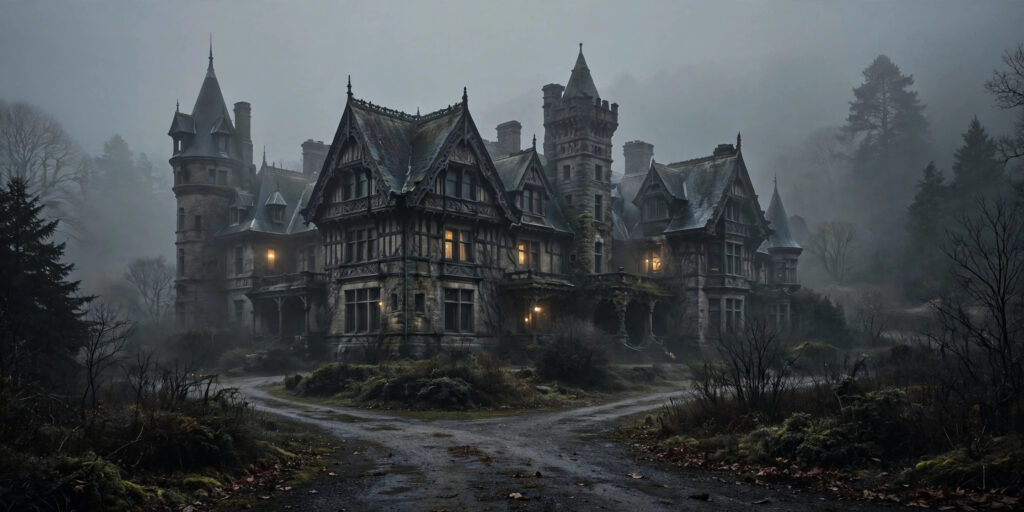
Reader’s note: supernatural accounts are presented as folklore and reported experiences, not established fact.
California doesn’t do anything small, and that includes its ghosts. This is a state built on stampedes — the Gold Rush, the oil booms, the Hollywood dream factory — and every boom left its residue: grand hotels with unfinished business, a prison island in the fog, ghost towns frozen mid-sentence. Few states pack this much documented history into their hauntings, which is exactly why California rewards the Atlas approach.
That’s the lens we bring to all of it at The Haunted Atlas. A haunted place earns its reputation when the folklore sits on top of something real — a building with a documented past, a ship with a service record, a town with a recorded tragedy. Below are twelve California locations with the history to back up the haunting, from a San Jose mansion built on grief to an aircraft carrier that recovered the Apollo 11 astronauts. Supernatural accounts are presented as folklore and reported experiences, not established fact.
Winchester Mystery House — San Jose
High in San Jose at 525 South Winchester Boulevard stands the strangest house in America: 160 rooms of staircases that climb into ceilings, doors that open onto sheer drops, and windows set into floors. Sarah Winchester, widow of rifle magnate William Wirt Winchester, built it from 1884 until her death in 1922 — and the legend says she never stopped building because a medium told her the spirits of everyone killed by Winchester rifles would claim her the moment construction ceased.
Here’s where the Atlas lens matters: historians have taken that legend apart. Sarah Winchester’s biographer found no evidence she ever met the Boston medium “Adam Coons” named in the famous 1967 account, construction paused many times (including after the 1906 earthquake), and the “séance room” was actually her gardener’s bedroom. The myth was largely manufactured after the house opened as a tourist attraction in 1923. But the building is genuinely, documentably extraordinary — a California Historical Landmark on the National Register — and the reports persist regardless: hammering from empty rooms, cold spots, a carpenter’s apparition staff call “Clyde.” The house is open for tours daily, and the architecture alone justifies the trip.
The Queen Mary — Long Beach
Permanently moored in Long Beach harbor, the RMS Queen Mary is a 1,019-foot Art Deco ocean liner with a service record most ships would envy: launched 1934, luxury liner through the 1930s, then the “Grey Ghost” troopship of World War II — so fast no U-boat could catch her — before retiring in 1967 to become a hotel, museum, and one of America’s most investigated haunted locations.
The hauntings cluster in a few famous spots. Watertight Door 13 in the engine room is tied to verified tragedy: on July 10, 1966, 18-year-old crewman John Pedder was crushed during a routine drill. Stateroom B340 is the ship’s most infamous cabin — flickering lights, faucets turning themselves on, shadowy figures — closed to guests for years before reopening with a paranormal package. The first-class pool belongs to “Jackie,” a little girl heard laughing and splashing in a room that’s been dry for decades — though ship records show no drowning ever occurred there, a good reminder that the best ghost stories sometimes outrun their paperwork. Ghost tours and overnight investigations run regularly.
Hotel del Coronado — Coronado
The red-turreted Victorian beach resort at 1500 Orange Avenue has hosted presidents, royalty, and Marilyn Monroe (during the filming of *Some Like It Hot*) since opening in 1888. Its ghost story is one of the most documented in American hospitality — and it starts with a verifiable tragedy. On November 24, 1892, a 24-year-old woman checked in alone under the alias “Lottie A. Bernard.” Five days later she was found dead on the hotel’s exterior staircase from a gunshot wound; the coroner ruled it suicide. Weeks of investigation finally identified her as Kate Morgan.
Her former room — now numbered 3327 — is the hotel’s most requested. Guests report flickering lights, televisions switching on by themselves, and the scent of perfume with no source. The hotel embraces it all with dedicated ghost tours, and the “Beautiful Stranger” remains one of the rare hauntings anchored to a real person with a real, documented ending.
Whaley House — San Diego
In Old Town San Diego at 2476 San Diego Avenue stands a brick Greek Revival house the Travel Channel once called the most haunted house in America — and its résumé backs up the billing. Thomas Whaley built it in 1856–57 for $10,000, a fortune at the time, on land with a grim pedigree: it was the site of the 1852 public hanging of “Yankee Jim” Robinson, executed for stealing a rowboat. The Whaleys reportedly heard his heavy footsteps in the halls from the day they moved in.
The house served as San Diego’s second county courthouse, its first commercial theater, and a general store — “more history than any other building in the city,” as locals say. Then came the family tragedies: baby Thomas dead of scarlet fever at 18 months, daughter Violet’s suicide in 1885. Visitors report apparitions of Thomas and Anna Whaley, children’s laughter from empty rooms, and the scent of Anna’s French perfume. Open daily as a museum, it’s the rare haunting where the family experiencing it documented it themselves, in their own lifetimes.
Alcatraz — San Francisco Bay
“The Rock” held America’s most notorious federal penitentiary from 1934 to 1963 — Al Capone, Machine Gun Kelly, Robert Stroud — on an island the local tribes reportedly considered a place of evil spirits long before any prison stood there. The reports started early: Warden James A. Johnston himself allegedly heard a woman sobbing during a tour, and guards in the 1940s logged “ghosts” in the isolation unit.
Cell 14D in D-Block, “The Hole,” carries the signature legend: an inmate screaming through the night about a creature with glowing eyes, found dead by morning. Capone’s banjo is said to still play in the shower room where he practiced. Whether residual haunting or the psychology of men broken by solitary confinement, the island’s atmosphere does the heavy lifting — fog, isolation, and 1.5 million visitors a year walking the same cellblocks. Book through Alcatraz City Cruises, the NPS-authorized ferry concessioner — the night tour sells out months ahead in summer. Note: the island is scheduled to be closed October 26–November 18, 2026 for dock repairs.
Preston Castle — Ione
Rising out of the Sierra foothills at 900 Palm Drive, Preston Castle looks exactly like what it is: a Romanesque Revival fortress built to contain troubled boys. Constructed 1890–94 with bricks made by San Quentin and Folsom inmates, it served as the Preston School of Industry — one of California’s first juvenile reformatories — from 1894 until 1960. Its wards included future country star Merle Haggard and Beat writer Neal Cassady.
The haunting centers on a real, unsolved crime. On February 23, 1950, 51-year-old head housekeeper Anna Corbin was found beaten to death in a basement storeroom; her killer was never found. Visitors report crying in empty corridors, apparitions in period clothing, and the particular heaviness of a building where thousands of harshly disciplined youths passed through. A California Historical Landmark on the National Register, it’s open for daytime tours nearly every Saturday — and for overnight paranormal investigations, if the daytime version doesn’t satisfy you.
Bodie — Mono County
East of the Sierra, down a long dirt road, sits the best-preserved ghost town in the American West. Gold was discovered here in 1859 by W.S. Bodey — who died that winter, never seeing the town misspell his name into history. By 1879 Bodie held nearly 10,000 people, 65 saloons, and a reputation a local reverend summed up as “a sea of sin, lashed by the tempests of lust and passion.” Fires in 1892 and 1932 gutted most of it; mining ended in 1942. Since 1962 it’s been a state park, preserved in “arrested decay” — interiors still stocked with dust-covered goods, as if the residents just stepped out.
Bodie takes “ghost town” literally in two ways. The famous Bodie Curse holds that anyone who removes even a pebble suffers misfortune until it’s returned — park rangers regularly receive mailed-back souvenirs with apology letters. (The curse was likely invented by the parks department to deter theft, which only makes the returned packages funnier.) Reported residents include “Evelyn,” the three-year-old “Angel of Bodie” in the cemetery, and a Chinese maid in the J.S. Cain House. Visit in summer; the road closes in winter.
Greystone Mansion — Beverly Hills
Behind gates at 905 Loma Vista Drive sits the most filmed mansion in Hollywood history — *Ghostbusters II*, *The Big Lebowski*, *There Will Be Blood*, dozens more — and the site of one of the city’s great unsolved mysteries. Oil tycoon Edward L. Doheny built the 55-room Tudor Revival palace in 1928 for his son Ned, at a cost of $4 million. On February 16, 1929 — five months after moving in — the 35-year-old Ned was found shot dead inside, in what was ruled a murder-suicide by his friend and secretary Hugh Plunkett. Both men were entangled in the Teapot Dome oil bribery scandal, and questions about what really happened that night have never fully closed.
The 46,000-square-foot estate became a public park in 1971 and is on the National Register. The reported activity fits the history: a man in a black suit and pork-pie hat on the grand staircase, phantom servants, cold spots — and the scent of lilacs attributed to Lucy Doheny, who lived to 100 and stayed in the house until 1955. The gardens are free and open daily; the mansion interior opens for special events.
Calico — Yermo
In the Mojave Desert off Interstate 15, Calico is the ghost town that got a second act. Founded in 1881 on California’s largest silver strike — 500 mines, over $20 million in ore, 3,500 residents by 1890 — it died almost as fast as it boomed when the Silver Purchase Act of 1890 crashed silver prices. By 1900 it was empty. Then Walter Knott of Knott’s Berry Farm — who’d worked in Calico as a young carpenter — bought the whole town in 1951, restored it to its 1880s appearance, and deeded it to San Bernardino County in 1966. It’s now a county park and California’s official Silver Rush Ghost Town.
The hauntings lean playful rather than grim: the old schoolhouse, the Mystery Shack, Saturday night ghost tours, and a full Ghost Haunt festival the last two weekends of October. It’s the most family-friendly entry on this list — gunfight shows, gold panning, and a heritage railroad alongside the spooks. Five of the buildings are original 1880s structures; the rest is Knott’s loving reconstruction, which the park is refreshingly honest about.
Mission Inn — Riverside
What began in 1876 as a 12-room adobe boarding house became, over Frank Miller’s 55-year obsession, one of the strangest and grandest hotels in America: a sprawling Mission Revival labyrinth of cloisters, catacombs, flying buttresses, and a five-story rotunda, on the National Register of Historic Places. Miller filled it with treasures from around the world and hosted ten U.S. presidents.
The hauntings are as eclectic as the architecture. Frank Miller himself is said to walk the halls, particularly near the library; his sister Alice appears on the fourth floor. Room 222, the St. Francis Chapel, and the bell tower are the reported hotspots, alongside a Woman in White, a playful child spirit heard laughing in empty corridors, and even a spectral wedding party glimpsed in formal attire. A $50 million restoration in 1992 brought the landmark back from near-ruin. Ghost tours run regularly — and the Festival of Lights each December draws half a million visitors, ghosts presumably included.
Hollywood Roosevelt Hotel — Los Angeles
Opened May 15, 1927, financed by Louis B. Mayer, Mary Pickford, Douglas Fairbanks, and Sid Grauman, the Roosevelt hosted the first Academy Awards in its Blossom Ballroom — 15 minutes long, $5 tickets. Its ghosts are Hollywood royalty. Marilyn Monroe lived here for two years early in her career, then still Norma Jeane Baker; her full-length mirror from Room 1200 now sits near the lower-level elevators, and guests report seeing a blonde woman’s reflection behind them, smelling Chanel No. 5. Montgomery Clift stayed in Room 928 while filming *From Here to Eternity* in 1953 — guests report trumpet sounds and a pacing figure whispering lines.
Staff say activity surged after the hotel’s restoration to its 1920s splendor, as if the building’s golden age woke up with it. The Blossom Ballroom gets cold drafts and flickering lights; a tuxedoed figure is seen looking for his seat at an awards night that never ends. It’s a working luxury hotel, so you can book the haunted rooms yourself — Room 1200’s mirror not included.
USS Hornet — Alameda
Berthed at Pier 3 in Alameda, the USS Hornet (CV-12) is the “Grey Ghost” of the Pacific: commissioned in November 1943, one of the most decorated ships in Navy history — 1,410 enemy aircraft destroyed — and the vessel that recovered the Apollo 11 and Apollo 12 astronauts. In 27 years of service, more than 300 people died aboard: combat, flight-deck accidents.
Decommissioned in 1970 and opened as a museum in 1998, the ship started generating reports almost immediately: footsteps and voices with no one aboard, apparitions of sailors in uniform who vanish, instruments switching on by themselves. Museum founder and curator Alan McKean has described seeing an officer in WWII khakis descend from the flag bridge — an encounter he recounted in 1999, shortly after the museum opened. The museum says around 200 sightings have been logged over the years. A National Historic Landmark, it’s open daily — and yes, they run overnight paranormal investigations, which is either the best or worst way to spend a night on an aircraft carrier, depending on your constitution.
Frequently Asked Questions
What is the most haunted place in California?
The Winchester Mystery House gets the most votes for sheer strangeness, the Queen Mary for volume of reports, and the Whaley House for the Travel Channel’s “most haunted house in America” crown. It depends whether you want architectural mystery, a floating hotel, or a family home with 170 years of documented tragedy.
Can you stay overnight in California’s haunted hotels?
Yes — and that’s half the fun. The Queen Mary, Hotel del Coronado, Hollywood Roosevelt, and Mission Inn are all working hotels where you can book the reportedly haunted rooms themselves (Stateroom B340 and Room 1200’s mirror are the famous requests). Preston Castle and the USS Hornet go further, offering overnight paranormal investigations.
Is the Winchester Mystery House really haunted?
The building is real and extraordinary; the famous backstory is shakier than the tours suggest. Historians have found no evidence Sarah Winchester ever met the medium at the heart of the legend, and construction paused regularly. That doesn’t stop the reports — it just makes the Winchester the perfect Atlas case study: magnificent documented history, with folklore doing the rest.
What is the Curse of Bodie?
Legend holds that anyone who removes anything from Bodie — even a pebble — suffers bad luck until it’s returned, and park rangers do receive mailed-back souvenirs with apology letters. The curse was most likely invented by the parks department to deter theft. Either way, removing anything from a state park is illegal, so the curse and the law agree: leave it where you found it.
Do these places offer ghost tours?
Most of them. The Queen Mary, Whaley House, and Mission Inn run regular ghost tours; Preston Castle and the USS Hornet offer overnight investigations; Calico runs Saturday night ghost tours plus an October Ghost Haunt festival; Alcatraz’s night tours are the gold standard but book out months ahead in summer.
Which California haunted places are free or cheap to visit?
Greystone Mansion’s gardens are free and open daily in Beverly Hills. Bodie is a state park with a modest vehicle fee. The Whaley House museum charges a small admission. Alcatraz requires the ferry ticket, which isn’t cheap — but it’s the single most worthwhile ticket on this list.
When is the best time to explore haunted California?
October, naturally — Calico’s Ghost Haunt and Preston Castle’s Halloween events lean into the season. But California’s haunts are year-round: Alcatraz in the fog, Bodie under summer stars, the Queen Mary on a quiet winter weeknight. The ghosts, if they’re there, aren’t seasonal.
California’s ghosts don’t whisper — they built mansions, launched ships, and founded towns, and then they stayed to admire the work. Twelve places, twelve histories, and the same quiet truth underneath all of them: where history lingers, something lingers with it.
Keep exploring
The Paris Catacombs: History, Hauntings & How to Visit
Twenty metres beneath the streets of Paris, in tunnels the city dug to build itself, lie the bones of more than six million Parisians — stacked…
Read story →
8 Haunted Places in Transylvania (Historic Guide)
Transylvania is the most famous haunted address on earth — and the place where the Atlas rule matters most. The Dracula story everyone arrives with is,…
Read story →
8 Haunted Hotels in Oregon You Can Actually Book (Historic Guide)
Oregon's ghost stories are easy to visit and hard to sleep in — in the best way. This list is different from a roundup of haunted…
Read story →